

The Psychology Behind Product Development: The “Why Does This Exist?” Audit & Sensory Architecture
Author: Francesca Diona Aguilar,
Senior Product Development Manager at Above Rinaldi Labs
The beauty market is more saturated than ever. Every day, new brands launch with formulas based on the latest social media trends and viral hero ingredients. Yet, the data behind these launches paints a grim picture for founders.
According to research from Harvard Business School professor Clayton Christensen, over 30,000 new consumer products launch every year, and up to 95 percent of them fail. When narrowing that data down to the Consumer Packaged Goods and beauty sectors, Nielsen research indicates that roughly 85 percent of new products fail to survive past their first two years on the retail shelf.
Why is the failure rate so staggeringly high?
At Above Rinaldi Labs, we know that the biggest threat to a new beauty launch is not a lack of marketing capital or poor branding. It is a fundamental lack of clear product strategy. A nice formula is simply not enough. Before our advanced compounding lab in Chatsworth ever begins the formulation process, I require every brand to pass a strict internal strategic review: The "Why Does This Exist?" Audit.
The Psychology of a Category Leader
I studied psychology in school. That background completely shapes the way I view the product experience, the reality of marketing, and the way I interact with the brand founders and R&D teams who walk through our doors.
Before I joined Fred Khoury and Kat Khoury at Above Rinaldi Labs in 2018 as the first hire in the product development department (now called formulations), I worked entirely on the brand side. I interned with a PD consultant and worked for a spa brand handling development, sales, and social media. I learned very early on that blending science with human behavior is the only way to build a beauty brand that survives.
Today, my core responsibility is taking our clients through the entire journey of product development from the initial concept all the way to commercialization. When a new brief lands on my desk, the very first red flag I look for is simple. The product must have a clear, defensible reason to exist.
Founders often sit down with me and say they have a nice formula or they want to use a trendy new ingredient that is going viral. My response is always the same. Why should a consumer choose this over everything else that is already sitting on the market? If you cannot answer that question, your product is not ready for the bench.
Real World Use vs. Lab Performance
There is a massive difference between designing an effective formula in a sterile lab beaker and making that formula work realistically in a person's life. A product must fit into a consumer's daily routine intuitively and consistently.
Standard contract manufacturers operate on a volume-based, order-taking model. They take a loose concept, mix up the requested trending ingredients into a generic base, and push the product straight to the filling line. They do not analyze human behavior or whether the product makes sense outside of a specification sheet. If a product fails on the retail shelf due to poor product-market fit, the standard manufacturer still gets paid. The founder/company takes the entire loss.
I approach formulation through a completely different lens. To survive the 85 percent failure rate and drive long-term repeat purchases, you must move beyond vague marketing hype and focus on three core pillars:
Defensible Positioning: Your product must offer a distinct, undeniable advantage over existing competitors on the retail shelf. If you are just launching another 10 percent niacinamide serum, you will be out-spent by legacy brands. You need a proprietary delivery system or a unique mechanism of action to defend your space.
Intuitive Routine Integration: The texture, application method, and dry-down time must make sense for a real person's daily life. If a morning serum is too sticky to wear under makeup, or a night cream ruins silk pillowcases, the consumer will never repurchase it no matter how good the clinical data is.
Immediate Perceptible Efficacy: The user must experience an immediate sensory or visual payoff. In human psychology, immediate rewards build habits. If a product takes 12 weeks to show results but offers no immediate hydration, cooling effect, or visual blurring on day one, the common consumer will abandon it by week three.
Inside the Audit: 3 Questions You Must Answer
When I first meet with an R&D team or founder, I do not ask them what ingredients they want. I ask them behavioral questions. Before our chemists start their initial trials, you must be able to answer these three questions:
1. Who is your direct competitor? Consumers only have so much space on their vanity. If someone buys your new moisturizer, whose moisturizer are they no longer buying? If you cannot identify the exact competitor you are displacing and why your formula will make them switch, your brief is not ready.
2. Does the sensory profile match the clinical claim? If you are selling a "calming rescue balm" but the formula is a thin, fast-absorbing gel, the psychology is disconnected. A rescue product needs to feel cushioning and protective. The chemistry must validate the marketing story the second it touches the skin.
3. Can this survive the compounding floor? A beautiful concept means nothing if it cannot scale. We map out the manufacturing reality on day one. If your psychological hook relies on suspended botanical beads, we have to engineer the shear-thinning matrix to ensure those beads do not crush in our compounding tank
Deep Dive: Sensory Architecture
Question two of the audit is often where brands fail. When a consumer picks up a new skincare product, their brain makes a subconscious decision about its efficacy within the first three seconds of use. This decision is entirely driven by sensory psychology.
Before a molecule of Vitamin C or a proprietary peptide ever penetrates your skin barrier, the consumer evaluates the product through touch, smell, and kinetic movement. If those sensory cues do not perfectly align with the promises made on your packaging, you will trigger cognitive dissonance. When the brain gets confused, the consumer loses trust.
At Above Rinaldi Labs, we do not just formulate for chemical stability. We build a sensory architecture that engineers the physical chemistry to validate your brand story.
Tactile Psychology, The Language of Texture: Texture is the physical proof of your marketing claim. If your strategic brief calls for a barrier repair rescue balm, the psychology demands a feeling of safety and insulation. We build a slow-melting, lipid-rich matrix that leaves a perceptible, comforting micro-layer on the skin. Every time the consumer touches their face hours later, they feel that layer and subconsciously think the product is still protecting them. Conversely, if you are launching an instant quenching serum, we formulate phase-shifting emulsions. The product might pump out as a structured gel, but the second the consumer rubs it in, the shear stress breaks the emulsion and floods the skin with a water-like burst. That physical transformation is the psychological trigger for hydration.
Olfactory Psychology, Engineering Trust Through Scent: The olfactory bulb has a direct neural link to the areas of the brain responsible for emotion and memory. Scent is the fastest way to manipulate how a product is perceived. If we are developing a highly active, medical-grade resurfacing acid, adding a sweet vanilla fragrance destroys the clinical credibility of the product. The brain associates those scents with basic body lotions. Instead, we leave the raw, slightly ozone-like scent of the actives intact. When the consumer smells that sharp, sterile scent, their brain instantly registers that the formula is powerful.
Visual and Kinetic Psychology, The Ritual of Application: If you are selling a luxury serum at a premium price point, the kinetic movement of the fluid must feel expensive. It cannot run down the hand like water, and it cannot drag like an ointment. We engineer the rheology so that it possesses a rich pull that glides effortlessly and suspends beautifully in the dropper.
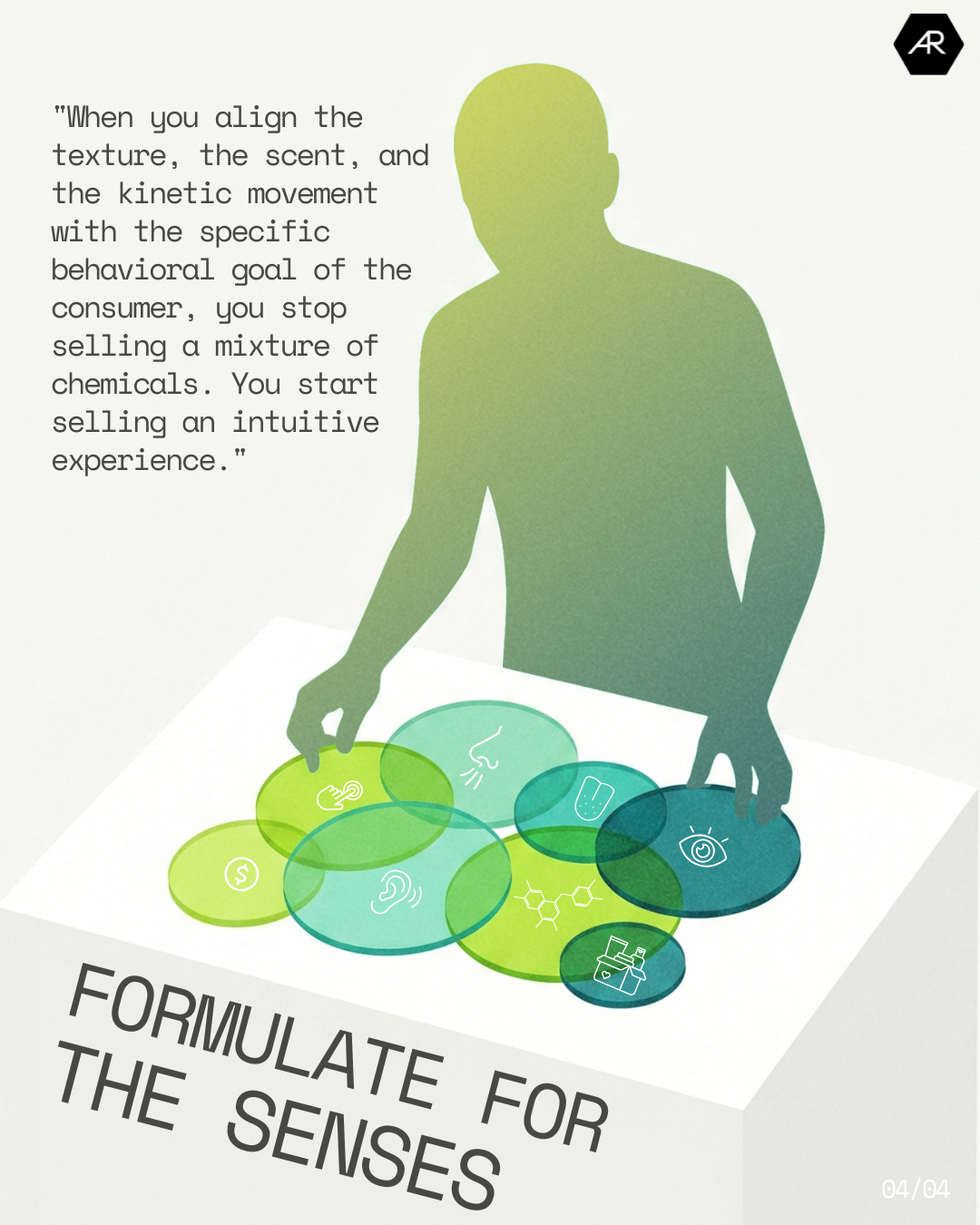
You cannot finalize your product story in a marketing meeting. The story must be written on the compounding floor. When you align the texture, the scent, and the kinetic movement with the specific behavioral goal of the consumer, you stop selling a mixture of chemicals. You start selling an intuitive experience. When a founder understands this level of sensory psychology, they stop asking us to just mix trendy ingredients. They ask us to build an architecture that forces the consumer to fall in love with the routine. That is how you build a product with a defensible reason to exist.
To survive a highly saturated retail market, you have to separate real science from marketing noise. Take "microbiome skincare," for example. I see this in briefs all the time, but it is largely marketing hype because most of the claims are completely vague and unproven. If I were building a product, I would ignore that buzzword and prioritize strengthening the skin barrier and reducing inflammation.
By focusing on barrier lipid replenishment, irritation minimization, and immediate perceptible efficacy, you indirectly support a healthy microbial ecosystem in a way that is actually clinically measurable and repeatable. More importantly, immediate sensory payoff is what actually drives real results and long-term use.
True Innovation and Saving the Launch
True innovation is shifting away from new hero ingredients. Visionary founders should be asking for proprietary, hard-to-replicate systems that make existing science work better. We guide our clients toward advanced delivery systems, biotech-derived actives, and using manufacturing as a true competitive advantage. That is how you unlock better efficacy, stability, and scalability.
Brands often come to us with formulas that their previous labs were completely unable to stabilize, replicate, or scale. Our team does a thorough investigation and ultimately creates a stable formula that matches your benchmark and actually survives the compounding floor. We have saved numerous retail launches where a brand was going to miss a major deadline due to an oversight or misstep in formulation from another manufacturer.
I am most in my element when I am creating. I love working with our chemists and putting our heads together to come up with amazing concepts and watching them come to life for our clients. If you are ready to build a product that has a defensible reason to exist and changes a routine, let us put our heads together.
The First Step in Formulating for the Future
Founders often assume the first step in cosmetic product development is mixing chemicals on the bench. In reality, the absolute first step is deep brief alignment and competitive analysis. Before we ever start formulating, we have to define exactly how this product fits into the market, who is buying it, and what behavioral routine it solves.
Even with a strong brief, many products still fail when moving from the lab to mass manufacturing because they were designed purely for lab performance instead of real-world scalability. If a formula is not engineered with the business aspect and the compounding floor in mind from day one, brands get stuck paying a fortune for unused chemicals and unstable batches.
Standard contract manufacturers act as order-takers, mixing ingredients without questioning the commercial viability of the product. At Above Rinaldi Labs, we are not a one-size-fits-all facility. We maintain our core values and work much more closely with our clients. By blending consumer psychology, product development, and elite engineering, we create lasting relationships and scalable products.
If you are ready to build a product that has a defensible reason to exist and changes a routine, let us put our heads together.
Click here to submit your project brief and schedule a strategic product development audit with the Above Rinaldi Labs team today
